moreBOOK REVIEWS
 BOOK REVIEWS'Significant Figures in Art and Craft Today'
'Significant Figures in Art and Craft Today' features 86 people representing a wide range of art and craft pursuits in England, Scotland and Wales. The book includes Bob Hobbs, Master Blacksmith, as well as a number of rural craftsman. An abbreviated version of the book can be viewed through the following link:
www.significantfigures.derekreayphotography.co.uk
This shows 14 of the 86 people as representative of the different areas of art and crafts covered, plus a full index of artists and craftsman by name and by occupation. The Foreword is being written by David Linley. Forge readers are offered a 40% discount (thus £15 plus p&p) to anyone who agrees to purchase copies before the end of December when the book goes to press. The book will be published in April 2011. The photographs will be exhibited during 2011 at St Ives/Redruth, Bath, Winchester, London, High Wycombe, Cambridge, Leominster and Leeds. Profits from the book are being donated to charity, Diabetes UK.
Further information is available from Derek Reay 07702 786643 / 01753 864928
BOOK REVIEWS
Feet first: Barefoot performance and hoof rehabilitation
By Nic Barker & Sarah Braithwaite. £16.49, hardback, 176 pages.
J. & A. Allen, 2009.
ISBN 9780851319605
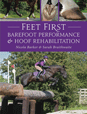
This book details the personal experiences of the authors ‘rehabilitating’ horses from being shod to being barefoot. It is well written and easy to read, perhaps too easy, as many concepts are only covered in a superficial way, using general language, which could be interpreted in several ways. Often the inference is that the shod foot is unhealthy, while barefoot is healthy.
The main themes of this book are that development of a healthy hoof is inhibited by shoes and the earlier that a horse is shod the less healthy the hoof and internal foot will be, as the digital cushion and collateral ligaments are prevented from maturing fully by the presence of shoes. Shoes are said to prevent proprioception, which is an awareness of the position of the body from neural receptors, which are present in the equine foot, thus making the horse’s foot insensitive to the differing types of surfaces it moves over. They also put forward that shoes peripherally load the foot, placing almost all the horses’ weight on the hoof wall, while the sole and frog are underutilised and, therefore, under developed.
Great emphasis is placed on introducing the correct diet before the shoes are removed, as the authors believe an incorrect diet can cause sole sensitivity when the shoes are removed. A whole chapter is devoted to the ‘correct’ diet for a barefoot horse.
Once the shoes are removed the authors believe that the foot and hoof are capable of growing better quality hoof walls more quickly, develop stronger digital cushions and grow thicker arched soles.
‘Sole sensitivity’ or footiness, is attributed to inappropriate diet and not to the absence of any form of physical protection to the foot and considered to be evidence that the horse has not yet been fully rehabilitated, requiring more time. Boots are mentioned on several occasions but no information on when or how they should be used is offered to the reader.
Some parts of the second half of the book repeat what has already been said earlier, this could have been avoided with better planning of the book’s layout.
I was particularly looking forward to reading chapter 11, ‘Troubleshooting – hoof problems, and how to avoid them’, but was disappointed to find that the problems were all the usual hoof problems, hoof cracks, seedy toe, thin soles and not specifically relating to being barefoot, or if they were this was not acknowledged.
There are numerous case histories used as examples throughout the book, illustrating some impressive improvements in the hooves after the shoes were removed. Unfortunately, Eric’s right fore foot on page 71 seems to have developed a dark stripe and a black patch of hair on his coronary band four months after his shoes were removed, this is careless of the authors and undermines the credibility of the rest of the book.
The last chapter has seven case studies, detailing each horse’s rehabilitation from shoes to being barefoot. Comments from many of the owners have been added at the end of each case study.
This book looks at the horses’ foot with a different viewpoint, many of the concepts have no scientific basis and the way equine foot anatomy is interpreted is suspect and in places incorrect, some of the themes offer a viewpoint which may be unfamiliar to farriers but should not be dismissed without further investigation.
As a farrier I would recommend the book to other farriers, to obtain a different perspective on the equine foot and to understand what is being said in the barefoot world, although a more moderate and pragmatic approach should be adopted when implementing some of what is suggested. Barefoot is another ‘tool in the box’ for a farrier and should not be ignored.
Tom Ryan, FWCF
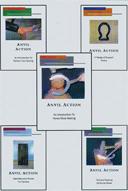 Anvil Action by P. Hampson & SonVolume 1.
An introduction to horseshoe making.
ISBN 9780955577604
Volume 2.
An introduction to farriery toolmaking.
ISBN 9780955577611
Volume 3.
A range of support shoes.
ISBN 9780955577628
Volume 4.
Hammers and knives for farriers.
ISBN 9780955577635
Volume 5.
Tool and fullering carthorse shoes.
ISBN 9780955577642
All volumes are A4 size and ring-bound. They cost £35 each and are available direct from the author. Available from P. Hampson, Clifton House, Mill Lane, Lindford, Hampshire GU350PE. Tel 01420 473963.
Anvil Action is a five-volume body of work covering forging techniques for shoemaking and tool making. It is thorough in its pictorial representation of all the basic shoes and tools associated with farriery. The text is restricted to comments alongside each photograph. The ring-bound volumes are titled: 1. An Introduction to Shoe Making, 2. An Introduction to Farriery Tool Making, 3. A Range of Support Shoes, 4. Hammers and Knives for Farriers, 5. Tool and Fullering and Carthorse Shoes.
The photography is excellent and you have to take your hat off to the methodical manner in which all techniques are shown. Colin Smith, FWCF, is acknowledged in the title page. As one of his students of 25 years’ past, I recognise his influence and can see his characteristic style throughout this work.
Volume 1 starts with a hind hunter shoe. Advice on pitch is that on the medial branch the pritchel on the ‘third (heel) nail slightly outward pitch’. This does somewhat contradict the advice to follow the angle of the wall. The volume continues with front, anti-brushing and caulk and wedge shoes as well as finishes with plain stamped and fullered shoes.
Volume 2 covers all the expected tools such as stamps, pritchels and tongs, and also how to re-shaft a hammer and even the making of pincers from old rasps. This last item was again well photographed at every stage.
Volume 3 goes back to shoemaking with a number of ‘support shoes’. Volume 4 moves on to hammers and knives. There is a great sequence of pictures showing the making of a loop knife and also a toeing knife, that is not the bayonet design usually seen today. This toeing knife is made by fire-welding an old rasp between mild steel prior to forging it into shape. As in all tool making sections there is clear guidance with regard to annealing and tempering. Volume 5 finishes the series with tooling and fullering and carthorse shoes.
Peter Hampson deserves credit for what is a huge task. Any farrier who can carry out all the tasks shown in these books is certainly a craftsman. As a comprehensive illustrated collection of forging skills, I know of no rival. Any training farrier can use it as an aide memoire and for an apprentice it gives helpful advice that will cover almost all the forging and shoemaking side of their NVQ Level 3.
Simon Curtis
‘Therapeutic Farriery. A Manual for Veterinarians and Farriers’
by Yehuda Avisar291 pages, hardback, $90. California, Hippus Publishing. 2007. The book can be ordered from www.hoofcare.com
This is a very well researched book and is well placed for the student in their final years of the ‘modern apprenticeship’ and, indeed, a very good book to start off your reading when preparing for the Associate Examination of the Worshipful Company of Farriers.
Published in 2007 this is the latest therapeutic shoeing reference book to come from the USA and find its way over the Atlantic to the UK. The book covers all aspects of shoeing, which have been compiled under five headings: The foot, locomotion, the foal, farriery techniques and therapeutic farriery. These are laid out into two columns of text per page with drawings and pictures relating to the subjects scattered throughout the book.
All of the pages are fully referenced to authors, making further research possible on any of the subjects covered. The author has gathered together a rich and informative text from a wide variety of authors including some of the valuable work done by Dr Alan Wilson and Chris Pardoe of the Royal Veterinary College, London. The author has farriery and veterinary qualifications and specialises in equine foot problems.
He has been conscientious and printed with the environment in mind, using techniques that reduce waste and the carbon footprint. Priced at $90 it is well placed when compared to other farriery books. Although it does lack colour pictures throughout; only having a handful in the centre of the book, the rest being black and white which is not ideal for cognitive (visual) learning in the student.
The language used (American/English) is easy to read, although you will need a fairly sound knowledge of equine anatomy (both American and English) to reap the benefits from each chapter. Some of the shoeing techniques shown would not be used on a daily basis, such as plywood shoes (page 94). The author may have been better to include modern shoeing methods, such as Imprint shoes, which are far more versatile and widely used.
Introducing more colour pictures to enhance cognitive learning would bring this book more in line with Simon Curtis’s books on corrective shoeing. That said, it is well worth reading due to its rich text, which is full of facts from many parts of the world.
Stephen Newman, CertEd, FWCF
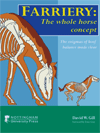 Farriery: The Whole Horse Concept. The enigmas of hoof balance made clear. By David W. Gill. 146 pages, hardback, £40. Nottingham, Nottingham University, 2007. ISBN 978 1 904761 55 6
Mr Gill has contributed a valuable resource for those seeking to enhance both their knowledge and practice of equine care. His book offers a welcome alternative to more opinionated, often narrowly conceived commentaries on farriery. Most importantly, it favours the essential role of reflective analysis in the evaluation of individualcases over the pursuit of universal ideals and reflexive performance of standardised procedures. The various concepts covered are elaborated by extensive and well-executed illustrations. I am gratified that the work of Jim Miller, Nyles Van Hoosen, and myself continues to resonate in such open-minded explorations of the marvellous complexities of equine locomotion and its relations to hoof care. My congratulations to Nottingham University Press for publishing this book.
Leslie Emery, PhD, co-author of Horseshoeing Theory and Hoofcare (1977)
This is what Nottingham University Press has to say about the book:
Foot balance is the main quintessential aspect of farriery and the questions of what is normal and what is undesirable have teased farriers and veterinarians for generations. A number of authors have set down their opinions but none have explored hoof balance in such detail. This book looks at anterioposterior and mediolateral hoof balance, not only defining what is normal and ideal but explaining how, through the forces imposed by the weight of the animal and the levers which make up the limb, the hoof can change shape.
Lameness and shoe loss are often considered a reflection of the competence of an individual farrier. This book will help provide the confidence and the evidence to help all parties involved in farriery to understand how form and function are inextricably linked.
This book is essential reading for those who are looking to expand their knowledge and for those who seek a more philosophical approach to this ancient craft. It starts as a journey of inquiry, reviewing the past and examining the present, objectively introducing to the reader the wider perspective of farriery; not just about ‘shoes on horses’ but as a benign manipulative therapy, which forms an integral part of the whole horse concept.
The Life and Times of a Hampshire Blacksmith.
The Story of the Preston Candover Smithy 1900-80 By Philip Sheail. 82 pages, paperback, £10. Published by Molewood Hawthorn, 2007 (available from www.bookshop.blackwell.co.uk). 2007. ISBN 978 0 9555684 0 4.
When this fascinating book landed on my doormat I had no idea what to expect from the title and what little I had been told about the book. Initially, it got placed on my pile of things to be done, then when I first opened the book to scan through some of the pictures I was amazed to see places I knew and sights I recognised from my rounds as a farrier.
I soon found myself standing on the main road of a small village called Preston Candover on the outskirts of Basingstoke in Hampshire. With the book open at the earliest picture of the village and trying to stand in the same spot as the photographer – having to avoid the cars rushing through and not seeing this attractive village – I was amazed at how little has changed since the turn of the last century.
From that point onwards the stories coming from the local blacksmith, Walter Murphy, put into print by his grandson Philip Sheail, had me totally enthralled. Not just because of the proximity to part of my own farriery round but the fascinating views of several generations of working blacksmiths in and around Preston Candover.
This book is a remarkable insight in to the work carried out and the way the blacksmiths and farriers had to adapt through the whole of the last century, not only delving into the recited stories from Walter but also through the meticulously kept records of his business throughout his working life.
Although these stories and accounts of villages, landowners and changes of village life and landowners, are specific to this small part of Hampshire, similar lives and stories must have taken place in thousands of hamlets all over the country, and anyone interested in the change of life style from the early 1900’s to today’s manic 2000’s will appreciate and gain a superb insight, through this book, into a bygone era of our working craft.
I would like to thank Philip Sheail for taking the time to put his grandfather’s life into print, so many stories and histories that would have just been lost to the speed of 21st century life.
Cliff Barnes
moreBFBA





morespecial offers
Subscribe Now For all your up-to-date news from BFBA subscribe now and receive 6 issues of Forge Magazine a year as part of your Membership package