CONTINUING PROFESSIONAL DEVELOPMENT - CPD
Pursuing Excellence in Farriery
The Farriery CPD Website has been introduced to support Farriers with their CPD needs. The website has been designed with you, the Farrier in mind, to ensure that you are able to easily access information on Events, Courses and Publications. You will be able to submit and record your own CPD points, access contact details for event organisers and plan your diary of events within your personal information area.
www.farrierycpd.org
CPD Informer 2010
You can find a list of event types that qualify for CPD points by clicking this link:
CPD Points
We would like to receive your comments on CPD events that you have attended.
 Continuing Professional Development (CPD) NewsMore exciting news for Forge Magazine - The CPD Informer will be incorporated from now on within Forge Magazine. This has been done to ensure the widest circulation of events and information and to consolidate costs. The CPD office will remain the point of contact for all matters relating to CPD issues and advertising events and general enquiries.
moreLATEST NEWS FROM THE CPD
For all the latest events Website
Managed by The Farriery Training Agency.
The CPD website will allow you to access upcoming CPD courses and events. In due course it will contain (or provide links to) important technical papers as well. You will also be able to plan your attendances and details of forthcoming events will be posted in good time so that you can plan well ahead. A facility is also available for you to record those events that you have subscribed to, with appropriate points values.
You can find a list of event types that qualify for CPD points by clicking this link:
CPD Points
Qualified members of professional bodies are increasingly being required to undertake Continuing Professional Development (CPD) to make sure that the high standards they had to achieve to become qualified are maintained while they continue to practice in their chosen profession.
To make sure that CPD is set up to suit farriers, the WCF, the FRC and NAFBAE formed a CPD Steering Group (CPDSG). Every farrier should aim to achieve a minimum of 10 points per year averaged over a three-year period. Farriers are provided with a certificate annually showing the CPD completed in the past year, and the points awarded over the past three years. Further information is available via WCF Website.
- Lifelong Learning
- Why record CPD?
- CPD Informer
- CPD Steering Group - what it's achieved so far
- Farriery CPD in England - my investment in life
- CPD Updates
- CPD completed record cards to be returned by end of December 2009
- Yorkshire farriers work together to achieve AWCF
- Why CPD?
Lifelong Learning
On 31 March the last meeting of the Continuing Professional Development Steering Group (CPDSG) took place at the Honourable Artillery Company Headquarters in London.
The CPDSG was formed three years ago jointly by the Farriers Registration Council (FRC), the Worshipful Company of Farriers (WCF) and the British Farriers and Blacksmiths Association (BFBA) to promote CPD and raise standards within the farriery profession. During this period the CPDSG have successfully introduced:
◗ A CPD website where CPD events are advertised
◗ Facilities within the website that allow farriers to review CPD events and book their attendance online
◗ Facilities within the website for farriers to plan and record their training
◗ A CPD record where farriers may enter their completed CPD details online
◗ Facilities for providers of CPD to forward the names of attendees to the CPD office at Sefton House where the farriers CPD attendance can be recorded.
◗ The issuing of CPD certificates annually to every farrier who completes CPD
The CPDSG has also worked closely with the Forge magazine, which distributes a copy of the magazine to every farrier and apprentice to promote CPD wherever possible.
Over the past year the CPDSG has been reviewing the CPD website following feedback from users that has resulted in some changes being agreed. Trials are due to take place in May, with final upgrades going live in June. Users will be able to see an upgrade in the presentation of the website with changes to the Home page, screen colours and help on how to browse the site to get the most from it. The site will also enable CPD providers to enter attendees details directly on to each farriers record.
Although the CPDSG has now completed its work its legacy will be to provide further recommendations to promote CPD as a high priority within the farrier profession. The organisations involved - WCF, BFBA and NFTA - will continue to work together on CPD.
Why record CPD?
CPD is about developing professional skills by going beyond meeting the base level standard; this strengthens your skills and gives you a competitive edge.
Many professions participate in and benefit from Continuing Professional Development (CPD). CPD is a method of improving your own learning within your work using a variety of ideas, techniques and approaches.
The aim of CPD is to keep your knowledge and skills up to date with information that is relevant to the work that you do. CPD builds your confidence and gives you a way to be able to document your achievements.
The requirements regarding CPD vary from industry to industry. Some have a relaxed approach, but others like the legal and medical professions, for example, have a fixed set of requirements that have to met within a specified time frame.
CPD does not follow a defined course of study. It is left to individuals to follow a path of learning that suits them (and the business they are in). The important part of CPD is increasing your skills and knowledge to improve your day-to-day business. This could be something done in your own time that changes how you think about communicating with others, or specific training courses, seminars or online learning.
Anything that helps you to meet the development objectives that you have set yourself can count towards your CPD if you record it. By recording and tracking your development, it is easier to see what you have learnt and therefore will help you to plan the best way forward to continue that development.
CPD Informer
In the December issue of Forge, CPD Informer looked at the many ways farriers can participate in continued professional development (CPD). CPD is all about being the best that you can be by investing in yourself and continuing your learning throughout your working life. The Diploma is the foundation to a profession in which there is plenty of opportunity to go on learning. This can be achieved by attending courses and seminars, via distance learning, viewing DVDs, studying for a qualification, giving presentations, taking part in a learning set, reading books and technical articles etc.
Some of the CPD opportunities that get a mention in the February issue of Forge are:
◗ Laminitis by Jim Ferrie, FWCF, a clear, straightforward article on this condition, its causes and how to go about treating it and applying a heartbar shoe
◗ Research: summaries of scientific articles (pages 21 and 34, full text available online)
◗ Enter a competition - farriery competitions are held all over the country
◗ Attend a clinic - Nigel Fennell is one farrier who will be holding clinics this year (page 14)
◗ EFFA will hold an educational event in Switzerland in October
(www.eurofarrier.org)
◗ Evening meeting at the Newmarket Equine Hospital (page 13 Forge Feb 11)
◗ BFBA National Farriery Championships, August 11 to 14 (page 23 Forge Feb 11)
◗ BFBA 32nd International Team Horseshoeing Championships,
September 30 to October 2
◗ Training day and farriery competition, March 4 to 5, Ipswich (page 24 Forge Feb 11)
And if none of these take your fancy, why not organise your own event.
The BFBA offers CPD in the form of Branch meetings and competitions, while the Worshipful Company of Farriers organises seminars and so on. Many farriery supply companies offer evening meetings, talks and courses (that are often free to attend, and they will even submit their attendance list to the CPD website to log your points for you). For more information, log on to www.farrierycpd.org; the site has a handy diary of forthcoming events, an area to record your CPD points and what type of activity constitutes CPD.
The CPD Steering Group requires farriers to gain 10 CPD points per year, averaged over a three-year period.
CPD Steering Group, what it's achieved so far
Since April 2008 the continuing professional development steering group (CPDSG) has:
➤ Made farriers aware of Farriery CPD administration set up within FTA.
➤ Agreed a points recording system for CPD, which is as being most effective recording method
➤ Set up a systems for annual recording, including certification
➤ Established a CPD website which is regularly updated
➤ Made CPD news and events a routine feature in Forge magazine.
➤ Made CPD providers aware of potential for advertising.
➤ Created and updated the CPD Points List
Looking ahead to 2011
Looking ahead, the CPDSG will:
➤ Maintain CPD annual records and certification, which will become web-based
➤ Update and maintain the CPD website
➤ Provide CPD news and events to Forge magazine.
➤ Deal with routine CPD related enquiries from farriers and CPD providers.
➤ Attend CPD meetings and respond to agreed actions.
Annual Farriery CPD delivery Costs from April 2011
The three organisations (WCF, FRC, and NAFBAE) agreed in February 2008 to fund up to £10k each for three years from April 2008 until March 2011. This has been used in the activities described above, but there is now pressure to reduce this expenditure and make CPD ‘self-financing’.
The CPDSG considered that CPD administration should be capable of being limited to one half-day per week once a suitable web-based system was set up, which would reduce the total cost of administration to about £10k per annum, and this needs to be implemented as soon as possible. On 10th March 2010, NAFBAE stated that it could no longer directly fund CPD activity, which has removed £10k from the available funding for this third year. The CPDSG believes that the FRC should agree that CPD is an essential part of making the farriery industry more professional. The CPDSG believes that with a small increase in the Retention Fee, CPD could be almost fully funded, with the balance being found from CPD providers paying for advertising on the CPD website etc. The sale of advertising space plus the accreditation of CPD providers will also add to the revenue. One provider has already paid £1,000 for formal accreditation by CPDSG.
To summarise what actions have been taken since the decision was taken to introduce CPD to the farriery profession (and most of these actions required a financial outlay):
1. Exploring ways and means to identify a workable (and simple system) to enable farriers to record their CPD activity (points per activity rather than time spent); this was decided upon after visiting/ discussing with several professional organisations (veterinary surgeons, physicians, paramedics) to see how they do it.
2. Deciding where CPD administration should sit - and the natural home seemed to the CPD Steering Group to be the FTA, putting all farrier training under one roof.
3. Identifying CPD providers and to advise them of the advent of a formal CPD programme for farriery.
4. Informing farriers about available courses.
5. Awarding a contract to a software house to come up with a design for an easy-to-access website carrying all CPD information. This involved several meetings with three agencies.
6. Facilitating meetings of the Steering Group - and there were several in the early years while we were sorting out all the above.
7. Introducing a pilot scheme by encouraging computer literate farriers to volunteer.
8. Getting the information out to the farriery community.
9. Responding to all the letters from disgruntled farriers who though that CPD shouldn't apply to them.
One of the decisions taken early on by the CPDSG was that the Steering Group would not organise CPD events. It was felt that there are plenty of CPD providers, and the group is there to steer, not to organise events (as in the CPDSG Terms of Reference). NAFBAE and the Company have provided (and continue to provide from time to time) courses or seminars. NAFBAE recently ran a pre-Diploma weekend for apprentice candidates, and the WCF Craft Committee is working on CPD events to take place at the Royal Veterinary College, Potters Bar, and at the Royal Bath and West Showground, Shepton Mallet.
The CPDSG works closely with the FTA and FRC carrying out the Steering Group's role which is ‘to formulate policy and produce direction for the monitoring and recording of farriery CPD in a cost effective manner, using existing resources where possible’.
Farriery CPD in England - my investment for life
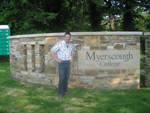
Jurgen Gotthardt is a German farrier who is studying the Foundation Degree in Farriery Science at Myerscough College. He takes his examinations next month; Jurgen’s CPD journey has meant he has driven thousands of miles pursuing his goal, and it is worth remembering that he is doing so in a second language. He wants to thank all the people who have helped him along his CPD path.
At first I will thank God who all the time has an eye on me, and perhaps he is my co driver when I am on the motorway to England and back to my country. And I thank my mother, a great lady; she had always a good line to the heaven. The course is tribute to my dead father, my first teaching horseman and to my parents-in-law Peter and Carole Hampson. Peter is a farrier in Hampshire, who has helped me together with his son William; I will never forget what they have done.
Since the beginning of the Foundation Degree Course I have travelled 30 times – every month 2500 km, a total of more than 1000 hours on the motorway – the staff at the harbour and on the ferry all know that I travel to Myerscough College.
However, a big thanks to my wife and family, they give me the opportunity to do it because we had also to do many other things at home, including to manage the work with my 25 Icelandic horses.
Next thanks go to all the great gentlemen in England – Angus Wiseman, Robert Atkinson, Wilf Ford, Craig D’Arcy, Cecil Swan, and David Gulley and my German friend Thomas Hardt (in Stafford) for all the help, hospitality, translating, pick-up service, drinks and food in the last three years.
Thanks also to the team from the Guy's pub and staff from Myerscough College; when I need help they give it. Thanks also for help by the translation problems to Sandy Nielson and Ulrike and Erich Sauerbrey (my local clients) and to Rainer Runge, with who I did practical on the horse what I have learned in the College.
But now I will thank to my student colleagues Richard Sayers, Richard Champness, Paul Shaun, Paul Brennan, Phil Hodgson; they were very helpful and never I had the feeling that they ignored me because I am a German.
Great thanks go to Wayne Preece, Sam Cook and Alan Calvert, three professional teachers in the College forge, also to Linda Quinn, from the forge’s office. She did every time a great job in this little office.
Greatest thanks go to Neil Madden; he was a fantastic teacher in the first year FdSc and thanks for the week in April 2008 when I visited him in Inverness, Scotland, where he is living and shoeing horses. Another greatest thanks go to Professor John Reilly, he knows always my problems, and he enjoys my translations!
But the greatest thanks goes to Mark Caldwell; he did open my head for so many inputs, that in fact to create better outputs everyday by shoeing horses, making shoes, working with the computer, creating files, putting bits together, using the head for thinking and muscles for doing the job, and he create something that I enjoy my life, special as a farrier. No other people teach me so well to do it.
The Foundation Degree Course means working online – part-time – distance-course with thinking, reading in library and internet, using special anatomical language when describing locations and diseases. It means professional communications, with vets and other farriers.
“Its your course and your chance, Jürgen” he explained, one time. Thank you Mark, you know my personally, conclusion and result.
Side effects to my CPD
I had also to improve my English language to read the books and understand them quite well.
I have found many interesting papers and books, and informations for the rest of my life as a farrier, to enjoy learning more and never stand still. Using modern tools for equine analysis and document files, images and informations. Select the information quality and how to get them, thinking about the materials and methods and where in the world it is be done.
It is a simple system, to use whatever you need to do; it is perhaps not to trim or shoe the foot as that is a biomechanical job. There may be nothing wrong, today horseshoeing depends on real situations, each case is different. It is and was amazing to use force pressure mats, slow motion videos and other modern farriery learning tools.
The golden British farriery standard is, in my opinion, where excellent skills meets basic knowledge. The Foundation Degree is more – Myerscough College staff and Mark Caldwell and his ‘friends’ put amazing good documents together and have created fantastic assignments.
I am sure that the new apprenticeship standard what is coming sooner and also the fellowship is address to professional and to offer best horse welfare or horse world class performance.
However, I have use the CPD card, and have put in all my 2009 activities in it.
Each of them was very good. Thank you England, I have enjoyed every hour.
CPD Updates
Why CPD? by Richard Bridges
You may wonder, why CPD? After all when you complete the DipWCF you are as fully equipped to be a farrier as it is possible to be – or are you? The answer of course is, no. Your farriery skills are, like all skills, perishable. CPD means just that. continuous professional development, which will enable you to develop and progress from the farriery foundation qualification which is the diploma. The craft is constantly moving and evolving and it is easy to be left behind.
The best farriers are those who spend a lifetime learning the craft – there is always something new, some new way of looking at and dealing with a problem. Horses, like people are unique, with no two exactly alike. Conformation, hoof and lower limb anatomy vary, and methods of dealing with them differ too. It is only by being constantly alert to the subtleties of difference and developments in farriery techniques that the fledgling farrier accumulates the knowledge to develop his or her skills to best advantage.
CPD Record Cards to be returned
ALL farriers to return their 2009 CPD Record cards to the CPD Office at Sefton House or alternatively enter details of their CPD activity on the CPD Website www.farrierycpd.org by the end of December 2009.
Yorkshire farriers work together to achieve AWCF
By Steven Hewitt, AWCF
Forging ahead – I write this, firstly, to offer encouragement to groups to get together and work towards achieving higher exams and, secondly to thank all those who gave their time so generously to help us. We started as a group of nine, of which half have now successfully passed their Associate level examinations of the Worshipful Company of Farriers and the others are partially qualified.
Working together is so much more rewarding than studying alone. You encourage one another, share ideas and keep the momentum going. There is a lot of help to be had out there to get you started. We found that by grouping together we had enough people to attend day courses at local forges, and we were particularly lucky to be given the use of Follifoot Forge, the home of Chris Pedley, AWCF, a successful graduate of the scheme!
Weekly discussions
We met at Follifoot every week to attend a discussion group. This proved to be a great forum for swapping ideas and discussing the revision we had (hopefully) done during the week. We would take along a shoe we had made, present it and discuss its use and effectiveness. This enabled us to gain practice in our presenting skills in preparation for the oral part of the exam.
It was also useful to have the help of experienced vets and farriers such as Hugh Davies and Richard Stephenson, who, as veterinary examiners, helped us in our preparation. Doug Bradbury FWCF came and spoke to us about what we were letting ourselves in for. He obviously inspired us as we all duly enrolled and sat the exam.
One-day courses and practical days
As we got into the course we had immeasurable help from Richard Ellis FWCF who helped us with advanced shoe making and fitting. And a ‘modern materials’ day with Andrew Poynton FWCF aided by Ross Mackie AWCF and Jon Stanley AWCF brought us up to speed with the latest developments.
Our thanks also go to Minster Veterinary Practice at Poppleton for help with radiography and so on, thereby building a vet/farrier working relationship.
The days spent with Martin Deacon FWCF, offered the opportunity to run through the practical aspect of the exam, while a two-day course with Simon Curtis FWCF HonAssoc RCSV and Stephen Gowing AWCF put us through our paces in a mock exam.
All of these exercises were held at Follifoot, which enabled us to spread the cost across the group making it good value. Mark Watson AWCF helped us with the theory part of the exam technique at Melton Mowbray. Mark is an inspiring teacher, and we are indebted to him for his help and patience in putting up with us!
We also gained support from the Registrar of the Worshipful Company Farriers, Captain David Goodall, RN, and this was much appreciated. I found him to be a great source of help with numbers and contacts, and he offered great encouragement for what we were doing.
Following suit
Jonathan Nunn has now started a group in Staffordshire area, which I hope will be the start of many to follow. Ours was created under the umbrella of the Yorkshire Farriers Education and Demonstration Association, and it would be marvellous if other groups such as NAFBAE could follow suit. It’s a great way of making new friends and better farriers, apart from having fun while you’re doing it.
Our aim now is to start a new group and help the last few to get those all-important letters after their names. This is a challenging exam, which takes time and commitment, not to mention an understanding wife or partner.
What next?
There are new heights to scale. We hope to sit our Fellowship next. I shall be there and hopefully so will the rest of our group. Chris, you had better get stocked up with tea and biscuits!
The successful members of our group received their AWCF certificates at the WCF ceremony on September 3, in London. They are: Chris Pedley AWCF, Dave Lynch AWCF, Sam Beeley AWCF and myself, Stephen Hewitt AWCF, and hopefully the others will soon follow.
Why CPD?Richard Bridges recently took over as chairman of the CPD Steering Group. Here, he describes the key benefits of managing your career through undertaking continuing professional development, why CPD Informer is now included in Forge, and ponders the question, ‘Why CPD?’.
CPD Informer has been incorporated within Forge magazine for two reasons. First, it will ensure the widest circulation of events and information as it makes sense to have farriery material in one publication rather than two and, second, it is more cost effective. However, the CPD office at Sefton House remains the point of contact for all matters relating to CPD issues, advertising events and general enquiries.
Please contact Vicki Davitt or Sarah Jane Millard at The CPD Office on telephone 01733 341393, or email them at [email protected]
You may wonder, why CPD? After all when you complete the DipWCF you are as fully equipped to be a farrier as it is possible to be – or are you? The answer of course is, no. Your farriery skills are, like all skills, perishable. CPD means just that. continuous professional development, which will enable you to develop and progress from the farriery foundation qualification which is the diploma. The craft is constantly moving and evolving and it is easy to be left behind.
The best farriers are those who spend a lifetime learning the craft – there is always something new, some new way of looking at and dealing with a problem. Horses, like people are unique, with no two exactly alike. Conformation, hoof and lower limb anatomy vary, and methods of dealing with them differ too. It is only by being constantly alert to the subtleties of difference and developments in farriery techniques that the fledgling farrier accumulates the knowledge to develop his or her skills to best advantage.
The diary section of Forge will include the details of farriery CPD events. There you will be able to check on what is happening in your area and plan which event would most suit you. You can also look at the website, farrierycpd.org which also has the events in electronic form. The points system will enable you to record attendance, but the record is only a record – what is important that lessons are learnt and incorporated into your skill sets. The CPD website is recommended as the first port of call for everyone, so get connected! It has the advantage of being updated as things occur. Comments are always welcome, and will help to develop and improve the service.
The other key point about CPD courses is that they enable you to meet and exchange views with other farriers. Farriery tends to be lonely trade. Single practitioners work with horses and, while they may – and hopefully will – interact with owners and vets there is relatively little scope for meeting other farriers in the usual course of work. CPD events encourage interchange and sharing of experience, enabling younger farriers to take advantage of the knowledge of more senior members of the trade. They also provide a social venue, which is an added attraction.
CPD events will be advertised on the website and in the Forge, and any CPD updates will be published there. The more farriers who make use of these events the easier it will be to run them, creating a virtuous circle of improved skills and expertise.
We all want a successful career. Whether you seek recognition, to work in a particular area, or want financial stability, your career is likely to be the route to achieving those goals. Professional development is the key to managing your career.
Professional development is a fundamental part of our working lives. It is the process by which we keep up-to-date with current practice and drives us to improve our skills. By staying interested and motivated helps to identify and take advantage of opportunities that may come our way. The thing that many people don’t realise is that CPD is something we do every day of our lives without even thinking about it. So, what that means is, if you can learn from something, you can count it as CPD. Now that is something to celebrate.
CPD Matters
Kent farrier, Chris Wiggins, was delighted to learn that he had earned one CPD point when his method for treating horses with enlarged or prolapsed frogs and weak heels, ‘Using a recessed frog support pad to treat horses with long toes and weak heels’, was published in Forge, June 2008, pp 14-16.
CPD Accreditation
CPD providers should contact the CPD office on 01733 341393 in the first instance for information on points allocation for events. Should the team in the CPD office be unable to clarify the correct points allocation they will pass the request to the CPD Steering Group (CPDSG). CPD points for each event will be awarded in relation to the duration, depth and breadth of the subject matter, quality of speakers, and so on.
Recording Points Earned
Points can be recorded online at www.farrierycpd.org, by providers supplying attendance lists to the CPD Office, by completing your CPD Record card or contacting the CPD office where CPD points are recorded.
CPD Points
Whilst CPD is voluntary, every farrier is encouraged to aim to achieve a minimum of 10 points per year averaged over a three-year period. The system started in 2008. The minimum target in 2008 was five points, in 2009, eight points, and from 2010 onwards 10 points per year. Farriers are provided with a certificate annually showing the CPD completed in the past year, and the points awarded over the past three years. A list of the points earned for events, and also a list of activities which do not count as CPD can be found on the WCF website at www.farrierycpd.org
BEVA Congress Farriery DayThe British Equine Veterinary Association recognises the importance of working with professionals, to help improve equine welfare and, this year, is holding a day (Thursday 10th September) of CPD dedicated to 'The Foot'.
Farrier's Registration Council members can benefit by registering at BEVA member rates saving delegates £80, with special rates for registered apprentices.
For further details please visit the website or telephone 01638 723557 for a registration form. Programme available for download.
Imprint Equine Foot Care New Farriery Techniques Hoof Repair and ReconstructionFriday 21st August 2009 - Whittington, Staffs.
This advanced training course will teach the qualified farrier how to recognise causes of poor horn quality and damaged hooves. It provides clear practical procedures to deal with symptoms and restore and maintain hooves to health function using materials that assimilate the natural hoof. (4 CPD Points).
Saturday 22nd August 2009 - Whittington, Staffs.
This essential course will help you in assessing the acute and chronic laminitic equine's feet and its on-going farriery needs and will include lectures, practical demonstrations and interactive discussions. (4 CPD Points).
Instruction in the use of a power hammer and how to make a range of farriery tools, with Peter HampsonCourses: First Friday of every month
Pritchels, Stamps, Fullers, Tongs, Buffers, Pincers, Turning Hammers, Cats Head Hammer, Nailing Hammers, Swage bocks for tool and fullering.
Spaces are limited to 2 participants per course. Cost: £100 per person.
For more details call Peter Hampson on 01420 473963. (4 CPD Points)
3rd Combined Seminars for Equine Professionals - Saturday 15th and Sunday 16th August 2009 - Warwickshire College, Morton MorrellSat 15th August - Agenda
08.30 - Registration & Refreshments
09.00 - Presentation by Mr David Gill RSS, AFCL Author of "Farriery: The Whole Horse Concept"
09.50 - Presentaion on "The Hoof Capsule"
11.00 - Refreshments
11.15 - Presentation on "Surgical Treatment for Limb Rotation for Foals" by Dr Chris Colles, BVetMed PhD MRCVS
12.00 - Lunch
13.15 - Presentation on "Vertical Limb Rotation on Foals Fore Limbs" by Mr Mac Head, FWCF
TBC - Hands on Treatment "For Muscular Treatment on a Foals Forelimb" by Emily Brittin, MCSP SRP Msc (VET PHYSIO) Refreshments
14.00 - Practical Demonstration - *"On Equine Dental Care - Prevention of Misalignment of the Head & Neck" by Mr Richard Hill Equine Dentist
17.00 Final Q&A
* To be confirmed
(4 CPD Points)
Sun 16th August - Agenda
08.30 - Registration & Refreshments
09.00 - Welcome Guests and Delegates plus Introduction / H&S
09.15 - Presentation by Mr Russell Guire BSc Hons (Equine & Human Sports Science) "Equine analysis on the Ridden Horse under Normal/Side Saddle"
10.15 - Presentation by Dr Chris Colles, BVetMed PhD MRCVS "Thermal Images used to Diagnose Back Problems"
12.00 - Lunch
13.15 - Ridden Observation of Two Horses with an Osteopathic View Presented by Mr Tony Nevin D.O.
14.15 - Demonstration on "How to fit a Normal/Side Saddles for Dressage" by Mr Mike Norton, Master Saddler & Registered Saddle Fitter.
15.00 - Refreshments
15.30 - Demonstration of "An Un-sedated Standing Osteopathic Treatment" by Mrs Liz Oakenfold
16.45 Q&A
(4 CPD Points)
CPD Steering Group New Chairman: Commodore Richard Bridges RNRichard Bridges took up the chairman's reigns from Reg How on 12 February. Richard joined the Livery of the Worshipful Company of Farriers in 1995 while still in the Royal Navy. He ran the Craft Committee for three years and retired as Renter Warden following the sudden death of his wife, Helen.
Richard says "CPD has been set well on the road by my predecessor, Reg Howe. Continuous Professional Development is essential for any farriery wishing to remain on top of the profession. The accreditation of the Know Foot Know Horse web site will provide a boost to web based CPD as will the fielding of the CPD website, planned to go live in March. I urge you to use these sites. While it is good to note the increasing interest in CPD it is a pity that the return of CPD cards has been so slow. It is critical that these cards are completed to allow planning and fielding of appropriate courses to fill the gaps."
know foot know horse.com by Darren Bazin AWCF and Brian Saunders AWCFWelcome to KNOW FOOT KNOW HORSE, this website aims to provide clear information in the form of short movie downloads covering everything farriery related. The downloads available provide information for apprentices, newly qualified farriers, experienced farriers, vets and horse owners.
This is a truly interactive site with members not only able to request movies if they are not able to find the information available but we also hope that members will be able to add their own movies of the skills and techniques that they practice. Visit their website or tel: 01536 761310.
CPD
CPD is supported by
The Farriers Registration Council (FRC)
The Worshipful Company of Farriers (WCF)
British Farriers and Blacksmiths Association (BFBA)