
ARCHIVE - frc 2010
October 2010 - Forge Magazine
 Archive - Forge Magazine - October 2010
Getting to know you - Meet the members of FRC Council
The Farriers Registration Council consists of 16 members who are appointed by various bodies laid down in the Farriers (Registration) Act 1975. Four members of Council are appointed following election, three members are appointed by the Worshipful Company of Farriers, two persons are appointed by the National Association for Farriers, Blacksmiths and Agricultural Engineers (now known as BFBA), two are appointed by the Royal College of Veterinary Surgeons and one each are appointed by various other bodies including the RSPCA, the Rural Development Commission, the Jockey Club, Scottish Enterprise and the British Equestrian Federation.
The role of Council members is to ensure its functions under the Act are carried out properly in the interests of horse welfare. It sets the standard for registration and runs the Register of Farriers making it available to the public. The Council’s Registration Committee provides support. The Council also has a duty to approve courses, qualifications and institutions providing training in farriery supported by the Visitation Panel. It has a statutory duty to consider complaints from horse owners through the Investigating and Disciplinary Committees; the latter has the power to remove persons from the register for serious professional misconduct. In addition it provides advice to Registered Farriers on professional conduct, acts as the competent authority for the profession of farriery for the purposes of EU legislation, investigates and prosecutes cases of illegal farriery and generally promotes high standards within the profession. The Council also delivers the Approved Farriery Apprenticeship through its operational division known as the National Farrier Training Agency and its Management Board.
Council members commit themselves to anything from three to 12 or more days a year providing their support and their expertise in a variety of ways. Members are not employed by the Council but, whether appointed or elected, they have the mutual and joint responsibility for Council’s decisions and policies. This is the first of a series of articles in which Council members provide an insight into their backgrounds and why they have chosen to be actively involved.
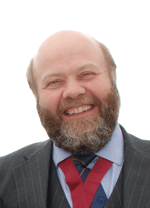 Huw Dyer
Huw is one of the BFBA’s two representatives on FRC Council, serving alongside Cliff Barnes. Since 2002, Huw has served the Council as a member of the Investigating Committee and on the Registration Committee. He joined the Finance Committee in 2008. From 1992 until 2007 he was a member of the Training Advisory Committee providing advice to Council on training and apprenticeship issues.
'I am a full-time working farrier and a partner in Londonderry Forge Supplies, Northallerton, with my wife, Jackie. I took an agricultural engineering and farriery course in 1972, before beginning my apprenticeship the following year under Bob Lapthorne. I remember well, as an apprentice, being shown how to do various things and deciding that I would try other ways to achieve the same goal! I was surprised how often the way I had been shown how to do a job turned out to be the best one. I successfully gained Associateship status in 1987.
'I work in a farriery practice along with three Registered Farriers and we have four apprentices. We all work both in the forge and on an ambulatory basis, travelling to race yards, livery yards and so on. Our farriery practice does a fair bit of heavy horse work. This came about largely because we work out of a forge. Some years ago, people who kept heavy horses found they had problems getting them shod, but because they could bring the horses to the forge, which is by far the best way of shoeing them, that side of the business has grown. I travel the country regularly, attend shows, compete, demonstrate, judge and am fully immersed in the profession. I believe I am approachable and contactable.'
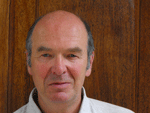 Andrew Roache
Andrew Roache has served on the Council since 2002. He is Chairman of the Registration Committee, which deals, among other things,with legislation affecting the Council, such as European directives affecting training and employment. He serves on the Investigating Committee, which considers complaints about farriers that may need to be referred to the Disciplinary Committee, and on the Finance Committee.
'I was appointed to Council by the Royal College of Veterinary Surgeons (RCVS), the assumption being that appointees will have the required sympathy towards equine welfare and the specialist knowledge to contribute in most spheres of Council activity. I believe these appointments remain valid and appropriate. RCVS appointees do not represent the College but perform their Council duties as individuals informed by their education and experience, and regulated by conscience and regulation.
'As a horse owner and a vet, I have long known how critical good farriery is to a horse’s welfare and performance. During my time in the army I was involved with the training and management of farriers as well as the care of horses. I was fortunate to work with some of the country’s most skilled and dedicated farriers, and to see at close quarters how good foot preparation and shoeing maintained soundness, and how effective skilful remedial shoeing could be. It is this contribution of excellent farriery to the welfare of the horse, which is at the centre of the Council’s responsibilities, and which I am keen to support.
'Linked to this is the respect and admiration I have developed for dedicated, skilful and hard-working farriers, who deserve their craft to be promoted, its standards maintained and protected and its contributions recognised.
'As an inspector for the Learning and Skills Council, I was a member of their team who performed the first inspection of the farriery apprentice scheme and I have also served on the WCF Examination's Board. All these experiences convinced me that good training and education can be inspirational as well as instructional, during an apprenticeship and throughout a career, and also that farriery training in this country is well managed and delivered. This is a situation that needs to be protected and developed and I welcome the chance to contribute to the Council’s work in this area.
My experience of farriers and farriery has been overwhelmingly positive, and I am sure this reflects the high standards of the craft generally. Such excellence does require the Council to act upon threats to standards from inside and outside the British farriery community, and I believe its disciplinary and regulatory work is vital. As in other areas of activity, farriery standards and good farriers should be protected for the sake of the horse but the benefits extend to farriers, horse owners and society.'
All Council Meetings are open to members of the profession, the press and the public. In order to confirm details of location and timing, and to gain access, applications (in writing, by email or telephone) to attend must be made to the Council offices at least three days before any meeting (email [email protected], telephone 01733 319911). Meetings usually start at 10.30 and finish at about 15.30. Meetings are held in March, June and November in London.
FRC Prosecutions
'The FRC investigates and prosecutes unregistered persons suspected of carrying out farriery when the evidence is sufficient to do so. In order to bring a prosecution it is always necessary to have a witness statement or other clear evidence. The Council employs investigators who can assist you in making a statement which would then be used as the basis of a Council prosecution or carry out surveillance in the hope of witnessing the individual themselves. Alternatively, persons are free to make their own complaint to the police and have the right to press the police to take action.'
Mr Antonio Saavedra prosecuted for illegal farriery
On 4 August 2010, Reading Magistrates Court found Mr Antonio Saavedra who was residing in Heckfield, Hook in Hampshire, guilty of having carried out unlawful farriery, reports the Farriers Registration Council.
Mr Saavedra, whose home country is Chile, is neither a Registered Farrier nor an approved apprentice. The allegation against Mr Saavedra is that on 4 February 2010 he undertook farriery on a polo horse at Mucho Polo Ponies in Shinfield, Reading. This was witnessed by an Investigator employed by the Farriers Registration Council.
Mr Saavedra failed to appear at Court and in his absence was found guilty of the charges against him. As a result, he was fined £200 and ordered to pay a contribution towards costs of £2,660.43 along with a Victim Surcharge of £15.
Unregistered persons engaging in farriery are breaking the law. Any horse owner choosing to use an unregistered person may compromise the welfare of their horse and could incur additional shoeing bills to correct the effects of poor workmanship. They would invalidate their insurance if an unregistered person lames or otherwise injures their horse. An unregistered person will not have professional indemnity insurance and therefore it would be very difficult to achieve redress not only for poor workmanship but also for accidental damage of any kind on a yard. If a horse owner knowingly uses an unregistered person he or she is aiding and abetting a criminal act which is also an offence in law.
The FRC maintains the Register of Farriers and all Registered Farriers are issued with their own annual Registration Card and Car Window Sticker. If an owner wishes to check the credentials of their farrier he/ she can ask to see the card, check the Council’s website, www.farrier-reg.gov.uk, or telephone the office on 01733 319911.
The Council will take out prosecutions against unregistered persons when the evidence is sufficient to do so. If you have any information regarding any alleged illegal farriery activity then please report it to the Council.
Mr D T Grunewald and Mr P A Grunewald prosecuted for illegal farriery
On September 6, Barry Magistrates Court found Mr David Thomas Grunewald and Mr Paul Anton Grunewald both of, Llanharan, Mid Glamorgan guilty of having carried out unlawful farriery.
Under the Farriers (Registration) Act 1975 (as amended) it is a criminal offence for anyone other than a Registered Farrier, approved farriery apprentice or veterinary surgeon to shoe a horse, or otherwise carry out farriery.
The Register of Farriers is administered by the Farriers Registration Council and it is Council policy to pursue a private prosecution when sufficient evidence is available.
Mr D T Grunewald and Mr P A Grunewald are neither Registered Farriers nor are they approved apprentices under the Farriers (Registration) Act 1975 (as amended). The allegation against these defendants was that during the morning of Friday 2 April 2010 they undertook farriery on separate horses at Stables in Cowbridge, South Wales. This was witnessed by an Investigator employed by the Farriers Registration Council.
Mr D T Grunewald and Mr P A Grunewald pleaded Guilty to the charges against them. This was the third time that they had been convicted and they were each fined £500 and both were ordered to pay a victim surcharge of £15 and make a contribution towards prosecution costs of £1000.
Interested parties can contact the Council’s Solicitor, Mr Peter W Marsh, of Peter W Marsh & Co, Pembroke Gardens, 19 High Street, Melton Mowbray, Leicestershire, (Telephone: 01664 566471) for further information in relation to this matter.
Mr Jack Burton and Mr William Burton prosecuted for illegal farriery
On 3 September 2010, Bishop Auckland Magistrates Court found Mr Jack Burton and Mr William Burton of Bishop Aukland guilty of having carried out unlawful farriery.
Mr Jack Burton and Mr William Burton are neither Registered Farriers nor are they approved apprentices under the Farriers (Registration) Act 1975 (as amended). The allegation against Mr Jack Burton and Mr William Burton is that on Wednesday April 14, 2010, both individuals unlawfully carried out farriery on separate horses at an equestrian centre in Durham, while being persons not registered in the Register of Farriers. This was witnessed by an Investigator employed by the Farriers Registration Council.
Both Mr Jack Burton and Mr William Burton pleaded Guilty to the charges against them. They each received a conditional discharge for 12 months and were both ordered to make a payment of £520 in respect of costs payable at the rate of £10.00 per week.
moreNEWS
- Archived Articles
- Archived Articles - WCF
- Archived Articles - WCB
- Archived Articles - EFFA
- Archived Articles - FRC
- Archived Articles - FTA
- CPD Points
- FAQ
- Training Courses
- Links
- Product Directory
- Results
morespecial offers
CPD Points Don't forget you can get 1 CPD point for writing a Farriery Related Article for Forge Magazine (max 4 points per year)
Attend a one day NAFBAE event for 4 CPD points, a half day is 3 CPD points and an evening event is 2 CPD points.
These include local meetings etc but exclude purely social events.
For further information contact the CPD office on 01773 341393.