
ARCHIVE - ARTICLES 2009

Feb 09 - Dissection of 22 cadaver limb specimens trimmed to UST, Duckett's dot & bridge,
geometric proportions and NVQ Level 3 standard trimming protocol
Feb 09 - Another View of Seedy Toe
 Archive - Forge Magazine - February 2009
Dissection of 22 cadaver limb specimens trimmed to UST, Duckett's dot & bridge, geometric proportions and NVQ Level 3 standard trimming protocol
By P.W. Balchin, D.W. Mitchell & M.N. Caldwell, Myerscough College, Billsborrow, Preston, Lancs PR3 0RY
Pythagoras’ theorem
In any right angled triangle, the area of the square whose side is the hypotenuse, (the side opposite the right angle) is equal to the sum of the areas of the squares whose sides are the two legs (the two sides that meet at right angles).
(Pythagoras of Samos, between 580-490 BC)
Summary
The object of this practical analysis was to quantify the optimum balance and proportions in categorised hoof shapes. This was achieved taking external predetermined reference points. Dissection and digital photography were used to assess whether these could be relied upon to provide optimum balance and proportions to a given hoof shape. Another object of the study was to establish what other internal factors influence hoof/foot shape.
Introduction
The significance of hoof shape has often been overlooked with regard to the co-ordination of external reference points to the internal structures, and hoof shape has long been considered a contributing factor in various diseases and pathologies of the hoof/foot (Balchin and Mitchell 2008).
Other factors known to influence foot shape are genetic predisposition, conformation, trauma or injury, health and hygiene, environment, load bearing forces and ground reaction forces.
A study by Dr Bob Bowker on the significance of blood supply and its relevance to horn growth, revealed that horses with little or no blood supply through the lateral cartilages had poor heel growth and angle, whereas a prolific blood supply through the cartilages lead to good heel growth, height and angle.
Measurement of external pathologies
Having trimmed the feet to required trimming protocols, the solar surface of all of the feet was carefully brushed with a soft nylon brush to remove any debris. Next, four separate linear measurements were recorded. These measurements were taken using Vernier calipers (Powerfix).
The measurement points were:
A. Bend in bar to mid point of lateral sulci – lateral.
B. Bend in bar to mid point of medial sulci – medial.
C. Length of central sulci of frog.
D. Width between last bearing point of heels.
Method of dissection
Dissection involved removing the hoof capsule from the limb while frozen, and this was achieved using an electric bandsaw (Dewalt DW738). The feet (complete) were photographed in a calibrated white photographic box and external measurements were taken using Ontrack software.
Once this had been carried out the solar surface of the feet were marked using a dryline marker, at pre-determined reference points, these lines were the points of dissection.
The reference points were:
Point of breakover.
Point of frog.
Point of force (theoretical).
Centre of rotation.
Half way between centre of rotation and last weight-bearing point of heel.
Last weight bearing point of heel.
Saggital at midline, dead centre.
Each foot was individually dissected and photographed; this was carried out while frozen to avoid any distortion of the structures during the process.
Firstly, the foot was halved at saggital midline dead centre, the lateral side was kept whole, cleaned off with boiled water, and a soft brush was used to remove any tissue fibres, and dried using a clean soft cotton towel. This process has to be carried out quickly because if not the boiled water freezes to the surface of the internal structures, trapping any tissue fibres and creating a reflective surface, which is not good for photography.
The next stage was for the lateral half of the foot to be placed in the calibrated white box and photographed. After this had been carried out, the medial half of the foot was dissected. This was carried out in the same way as before. However, this side of the foot was dissected using six frontal planes starting at the point of breakover and at the same angle as the dorsal wall, working back through the foot to the last weight bearing point of the heel so that all of the other planes were included. Each picture was taken dorsal/palmar and once this had been carried out the foot was wrapped in a plastic bag and placed back in the freezer in case it was needed for future reference. This process was carried out on all 22 feet.
The memory card was removed from the camera and loaded onto a computer and the pictures cropped, enhanced (using Windows Vista) and labelled in preparation for loading onto Ontrack.
Twenty-two individual files were created (one for each foot) and between eight and nine pictures were loaded onto each file, so that each file had two saggital shots, one point of breakover, one point of frog, one point of force, one centre of rotation, one halfway between centre of rotation and at the last weight bearing point of the heel and one last weightbearing point of the heel. Each picture had specific points of measurement, but they had to be calibrated first, and this was achieved using the aluminium rule that had been positioned in the base of the photographic box as this would be clearly visible in the pictures.
Points of measurement
Saggital plane
Vertical wall height; angle of frog stay; dorsal wall thickness; vertical height of white line; sole thickness at point of breakover; distance from tip of P3 to distal toe; ground bearing surface length; hoof angle; P3 angle; centre of rotation from bearing surface; centre of rotation to point of force; frog stay to bearing surface; thickness of digital cushion under centre of rotation; widest point of frog to centre of rotation; widest point of frog to point of force; widest point of frog to point of breakover; thickness of digital cushion under centre of flexor surface of distal sesamoid.
Medial point of breakover
Vertical height of white line; vertical height of dorsal wall from hairline to bearing border; sole thickness; dorsal wall thickness.
Medial point of frog
Joint space of distal-interphalangeal articulation; sole thickness at the white line hoof wall interface; distal border of P3 to sole corium; distance from distal edge of P3 to bearing border of hoof wall; dorsal wall thickness; thickness of lamina interface; dorsal wall thickness at bearing border.
Medial point of force
Angle of dorsal wall; thickness of dorsal wall; sole thickness; angle of cleft; length from cleft to white line.
Medial centre of rotation
Angle of dorsal wall; angle of cleft; sole thickness; dorsal wall thickness; distance from hairline to bearing border; distance from bearing border of dorsal wall to midline dead centre; length of cleft; halfway between centre of rotation and last weight bearing point of heel; dorsal wall thickness at bearing border.
Length of cleft; dorsal wall height; sole thickness; bearing surface of dorsal wall to midline dead centre; angle of cleft.
Results
1. True point of frog is approximately 45 mm palmar to the point of breakover.
2. The location of the point of force was dorsal/distal to the insertion of the common digital extensor tendon and dorsal/proximal of the insertion of the deep digital flexor tendon at 90° to the centre of rotation of the distal interphalangeal articulation.
3. Point of force is, on average 9.7 mm palmar to the true point of frog.
4. A perpendicular line through the centre of rotation would appear on average to bisect the foot 60% dorsal and 40% palmar of the ground bearing border.
5. The average distance between the centre of rotation and the point of force is 19.02mm.
6. It appears that the greater the distance between the centre of rotation and the centre of pressure the lower the centre of rotation is in the hoof capsule.
7. The greater the angle of the dorsal wall the more proximal the palmar aspect of the digital cushion using the centre of rotation as a reference point.
8. Wall thickness equals the height of the white line.
9. Thickness of the sole is two-thirds the thickness of the dorsal hoof wall.
10. Distal border of P3 is equidistant to the dorsal hoof wall +/- 0.13mm around standard deviation of 4.34mm at point of force and 4.22 mm at the dorsal distal toe.
11. The centre of rotation is located 47.3% along the longitudinal axis of the frog from the last weightbearing point of the heel to the point of breakover.
12. Sole thickness under the point of breakover was found to be on average 4.96mm with foot D being the thinnest at 3.5mm and the thickest being foot T at 7.47mm.
13. In all cases, the digital cushion was thicker under the centre of the flexor surface of the distal sesamoid than under the centre of rotation by an average of 4.21mm.
14. The thickness of the sole under the point of breakover added to the thickness of the wall equals the vertical height of the white line.
15. The average distance of distal P3 to toe was 23.43mm.
16. The angle of the frog stay group average was 38.5.This showed a correlation of the greater the distance of P3 to toe the higher the angle of the frog stay.
17. The group average P3 angle was 34.8.
18. The group average centre of rotation to centre of pressure was 19.4mm.
19. The contour of white line follows the solar arch.
20. The vertical height of the white line is 13.21mm across the group.
21. The average frog cleft angle for the group is 104.2 degrees.
Discussion
Results indicate that external reference points used to evaluate static hoof balance are generally representative of the internal anatomical structures to which they are said to relate.
It would appear that sole thickness is relatively uniform with the exception of the area directly beneath the centre of pressure, where there is a noticeable increase.
Observations
In the process of photographing and analysis of the dissected feet it was noticed that a clear pattern was forming, which was visible on the saggital pictures.
A line from the hairline to the bearing border of the dorsal wall at the toe, taken from the bearing border at the toe to the last weight- bearing point of the heels and then taken from this point back to the hairline at the dorsal wall forms a triangle.
Out of the 22 feet that were dissected 16 formed the perfect ‘golden ratio’ and Kepler’s triangle and the six feet that did not were out by no more than 10mm at the maximum.
When the golden ratio and Kepler’s triangle were positioned onto the foot using the Ontrack software, it was interesting to note that the centre of the triangle was located at the exact point where the deep digital flexor tendon inserts into the semi lunar crest on the solar surface of the distal phalanx.
So could it be that by using a combination of geometric proportions, Duckett’s Dot and Bridge, uniform sole thickness and NVQ level 3 trimming protocol, the optimum method of foot trimming protocol has been discovered. If this were the case, Kepler’s triangle and the golden ratio could be accused of confirming this.
This area is worthy of greater research.
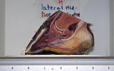
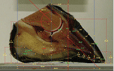
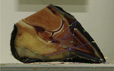
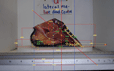
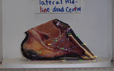
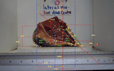
Captions Left to Right, Top to Bottom - 1. Saggital dissection of foot H; 2. Saggital dissection of foot H, applying the golden ratio and Kepler triangle; 3. Saggital dissection of foot R; 4. Saggital dissection of foot R, applying the golden ratio and Kepler triangle.
Mathematical links
The golden ratio
‘The golden ratio is a universal law in which is contained the ground-principle of all formative striving for beauty and completeness in the realms of both nature and art, and which permeates, as a paramount spiritual ideal, all structures, forms and proportions, whether cosmic or individual, organic or inorganic, acoustic or optical; which finds its fullest realisation.’
(Adolf Zeising, 1854)
The significance of the Golden ratio has been recognised for thousands of years, (long before the Pyramids of Giza and the Parthenon), and the likes of Pythagoras, Kepler and Zeising have devoted lifetimes to studying it. Even Leonardo da Vinci’s vitruvian man was drawn to this ratio.
One of the greatest points of interest with the golden ratio is the fact that it is not an exact science, the words roughly and approximately are just some of the words that are regularly used when referring to it, and this is by the worlds top mathematicians, so there is obviously a certain degree of leeway.
Kepler triangle
The Kepler triangle is a right angled triangle with edge lengths in geometric progression and this geometric progression is linked to the golden ratio and also to the theorem of Pythagoras.
Johannes Kepler, (1571-1630)
Materials
22 cadaver limb specimens, chosen by reference type
Electric bandsaw (Dewalt DW738)
Freezer
Digital cameras (Fuji Finepix and Kodak C875 Zoom)
Tripod
Sony Vaio VGN-AR51E laptop
Ontrack software
Calibrated photographic box
Digital Vernier calliper (Powerfix)
Clean boiled water
Latex gloves
Hibiscrub
Dryline marker
Tooth brush
Clean towels
White matt paint (Leyland)
Soft nylon brush
The calibrated photographic box was made especially for the study. It consists of a base, back and two sides, and measures 30cm square with an elevated plinth of 15cm diameter, to enable better visual access. The back of the box has two brass straight hooks screwed into it, approximately 24 cm up from the base. These hooks enable the subject to be labelled, using a rectangular piece of white board measuring 15cm x 9cm with two 8mm holes drilled in it on the top long edge, 2cm from each end. The rectangular piece of white board has the subject title written on it using the dry line marker and then it is positioned in the back of the calibrated box, suspended from the two brass hooks. The rectangular piece of white board is clearly visible, along with the title of the subject in the background of the photographs.
The box and the elevated plinth are painted matt white using Leyland white undercoat. This clearly enables the subject to be distinguished from the surrounding environment as this is essential for the accurate positioning of points of measurement. The reason for the box being painted with matt paint is so that there is minimal glare from the surrounding light sources, and this reduces flashback from the camera flash as this was set to automatic.
Archive - Forge Magazine - February 2009
Another View of Seedy Toe
In response to the article on seedy toe in the October 08 issue of Forge [page 6], Anthony Bailey, RSS, of Dorset, offers the results of his own work on donkeys with this condition.
As regards photos 6 and 8; is it acceptable to leave a donkey as mutilated as this, albeit in a good cause? This particular course of action can drag on for months. Using this method, the farrier may eventually clear the hooves, only for it to restart a couple of trims down the line.
A radical rethink on the treatment of this condition is called for, and I think I have the answer; it’s really simple and may generate more income. During the course of my work I have noticed that applying a shoe to the donkey hoof stimulates the coronary band to grow disease-free hoof wall.
Consider photo 3. Illustrated is a hoof trimmed conventionally flat, and what do we see? Deteriorating horn around the toe of the hoof.
For some years, now encouraged by donkey trimming competitions, some take a toeing knife or clippers and remove the unhealthy hoof tissue back to healthy laminae. They proceed to scrape that as well, as shown in photos 5 and 7. The result the donkey is walking round on a mutilated digit.
I may have found another way to treat these animals but I need colleagues to try it out. Here is how to do it...
Stop trimming at the stage demonstrated in photo 3. Measure the hoof and make a shoe from 5/8x5/16 concave [or similar] with two clips, i.e. big staples with the heels forged outwards and four nail holes. Fit and nail on.
The shoes should be left in place for 10 weeks before refitting. After such an interval, inspect the coronary band and you should find a healthy ridge just distal to the coronet, which is new growth brought on by concussion as a result of application of shoes.
Providing the donkey is not a dropped soled laminitic, it has worked on the few times I’ve tried it.
This method of leaving the diseased horn to grow out does not work with horses and ponies; in fact I’d say it would hinder a result. An approximate period of 15 months shoeing care is required to clear the most serious diseased condition.
However, unless the donkey is shod periodically, the whole scenario can occur again. This may mean you lose the client because they see it as a failure on your part; and may well choose a farrier who just trims and ignores the condition.
Other farriers may like to try this method and report results to Forge. I wish you all luck, as donkeys are rarely grateful for our ministrations, but we should do something for them in this temperate climate.
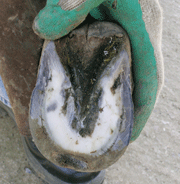
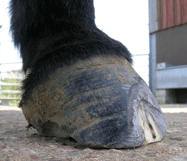
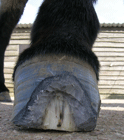
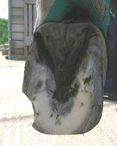
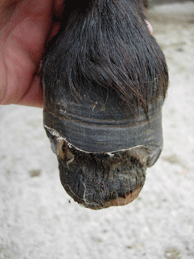
Ref Nos Left to Right: 3, 5, 6, 7, 8
moreNEWS
morespecial offers
CPD Points Don't forget you can get 1 CPD point for writing a Farriery Related Article for Forge Magazine (max 4 points per year)
Attend a one day NAFBAE event for 4 CPD points, a half day is 3 CPD points and an evening event is 2 CPD points.
These include local meetings etc but exclude purely social events.
For further information contact the CPD office on 01773 341393.