education and training
 HEREFORDSHIRE AND LUDLOW COLLEGE
Contact: Herefordshire and Ludlow College, Centre for Rural Crafts, Holme Lacy, Hereford HR2 6LL.
Tel: 01432 870316 Website
Herefordshire and Ludlow College, Warwickshire College and Myerscough College, which took over responsibility for farriery apprenticeships training provision in September last year, have been judged by Ofsted as making ‘significant’ or ‘reasonable’ progress in recent monitoring visits. The Farriery Apprenticeship Steering Group (FASG) – a body made up of the Colleges, the Skills Funding Agency and industry organisations – has overseen the transition of training from the National Farriery Training Agency (NFTA) to the colleges.
Herefordshire and Ludlow College (HLC) Principal, Ian Peake, commented: ‘I am delighted with the extremely positive views expressed by Ofsted of the progress we have made after taking on the Farriery Apprentices directly. We have worked hard to rectify a range of issues and are now very well positioned to take a leading role in providing education and training to this important industry. Approved Training Farrier (ATF) training days, countrywide visits to ATFs and a focus on open communication have all been key elements in ensuring that HLC meet the needs of its apprentices.’
Warwickshire College Vice-Principal, Diane Whitehouse, said: ‘We are really pleased that Ofsted have acknowledged the rapid progress we have made over the past few months. Our staff have put in a lot of effort to address the historic issues and build strong relationships with our apprentices and ATFs so we were delighted with the positive response to our ATF training day. Our focus is very much on the experience of apprentices in the workplace, and our developments in e-learning and support between blocks has been recognised. We will continue to work closely with all our partners to ensure that our apprentices receive high quality training in a safe and supportive environment.’
Ann Turner, Principal at Myerscough College added: ‘At Myerscough the inspectors were particularly impressed with the systems the College has put in place to protect apprentices in the workplace, the support mechanisms we provide, and our online learning network, BLOOM. They noted the obvious commitment of the College’s teaching and support staff and the way that Myerscough has worked closely with the professional bodies to manage the change to the new system and the work done to focus on the gender imbalance within the industry, and increase the opportunities for females in the workplace.’
 WARWICKSHIRE COLLEGE
Contact: Sue Robbins, Warwickshire College, Moreton Morrell Centre, Moreton Morrell, Warwick CV35 9BL.
Tel: 0300 45 600 45. For further information Contact Warwickshire College
Latest course information for Sept 2013 ...
View more about becoming a farrier here
View courses here
Farriery Accesss Course - NPTC - Designed for those who want to gain a farriery apprenticeship. Course Ref Code WC151 - Moreton Morrell Centre
One year - Full Time. You will develop the forging, horse care and other skills needed to be useful to an Approved Training Farrier (ATF).
Advanced Apprenticeship in Farriery - Warwickshire College. The apprenticeship lasts for a minimum of 4 years and 2 months, and must be served with an Approved Training Farrier.
Blacksmithing & Metalwork - National Certificate (1 year) or National Diploma (2 years).
2010 Moreton Morrell Annual Open Day
15 May 2010
 OATRIDGE COLLEGE
Contact Stephen Gowing or Jim Petrie, Information Unit, Oatridge College, Ecclesmachan, Broxburn,
West Lothian EH52 6NH. Tel: 01506 864400. Website
Oatridge offers a full-time, one-year pre-entry course for the would-be farriers, leading to a Certificate in Pre-Farriery and a four-year Advanced Apprenticeship in Farriery. Also offered is a Diploma of the Worshipful Company of Farriers. Conscious of recruitment problems in some industry sectors, Jim Petrie, who heads the college's department of farriery and engineering, is currently planning a one-year full-time entry level course which introduces students to a range of skills.
C&G 7485-01 Level 2 Certificate in Forgework - click here
 MYERSCOUGH COLLEGE
Higher Education Farriery Courses:
Myerscough College (Preston):
Delivered online:
Online and Blended Learning:
BSc (Hons) Farriery (Top-up) >> more info
Diploma of Higher Education Farriery>> more info
Foundation Degree - Farriery (On-line)
BSc (Hons) Farriery (Part-time)
First Diploma in Blacksmithing and Metalwork (pre-farriery)
NPTC Level 2 certificate in Forgework.
Link to Higher Education Farriery Courses - Click Here
HEREFORDSHIRE AND LUDLOW COLLEGE
Contact: Herefordshire and Ludlow College, Centre for Rural Crafts, Holme Lacy, Hereford HR2 6LL.
Tel: 01432 870316 Website
Herefordshire and Ludlow College was at the Three Counties Show 2013 - read more
Farriery Access Level 2 - click here
Full-Time Courses at Herefordshire and Ludlow College - click here
click here
Part-Time Courses at Herefordshire and Ludlow College- click here
Blacksmithing, Farriery, Metalwork & Welding - Hereford - click here
Level 3 Extended Diploma in Blacksmithing & Metalwork - click here
Introduction to Blacksmithing - click here
Blacksmithing, Welding - click here
 Cold Hanworth Forge and Blacksmithing School
Based in the heart of Lincolnshire and is renowned for their craftmanship in ironwork.
Under the guidance of professional blacksmith Bob Oakes, they also offer professional and vocational blacksmithing courses as well as training and tuition in blacksmithing and forge work for all levels of ability.
Web Link
A new era in farriery training is now ready to launch in November 2013.
There has been a period of uncertainty for all potential farriery apprentices, with new apprenticeships stopped following a critical Ofsted inspection of the National Farriery Training Agency in February. Now, after weeks of working with the main farriery organisations, three colleges - Herefordshire and Ludlow College, Myerscough College and Warwickshire College - are preparing to take over full responsibility for delivering the apprenticeships.
Tristan Lambert from London was hoping to start his apprenticeship this month. On hearing the news he commented: ‘I’m really happy that the problems have been sorted out so quickly and I’ll have the chance to start an apprenticeship soon. I’ve been working towards becoming a farrier for over two years now so was gutted when I found out that I could not start my training in September. It is great news that I will have that chance soon.’
Speaking on behalf of the three colleges, Rob Dunn, Assistant Principal at Herefordshire & Ludlow College, said: ‘We are thrilled to have the opportunity to move into a new era of closer working relationships with Approved Training Farriers and their apprentices. We look forward to getting to know our partner employers and apprentices better, and together training world-leading farriers.’
Gavin Moody, a farrier from Bury St Edmunds, who currently trains one apprentice and is keen for a second to start soon, welcomed the new arrangements, saying: ‘I am looking forward to working more closely with the colleges and seeing the training improved for everyone.’
Lecturer forges timely TV career
HIS travels through time have left him missing his Victorian life, especially his period clothing and mutton pie.
Kingston Maurward College lecturer Simon Grant-Jones is one of the stars in BBC One’s brand new series show Turn Back Time - The High Street, which starts this week. (Nov 2nd)
A group of modern-day shop keepers - a baker, a butcher, an ironmonger and a grocer - set up shop in the picturesque market square of Shepton Mallet in Somerset.
Simon Grant-Jones and his fellow traders completely immersed themselves in the lives of their trades, living and working exactly how they would have done during the last century, charting how their lifestyles and shops change.
Beginning in the Victorian era the show passes through Edwardian and war time before concluding in the retail frenzy of the 1970s.
“I loved every single minute of it,” said Simon, 46, who teaches forgework at the Dorchester land-based campus - and was the show’s ironmonger.
He has his own forge at his home in Sutton Poyntz and this year became the new National Champion Blacksmith after putting his work before judges in qualifying agricultural shows.
“I’m really interested in history so jumped at the chance to live it for real.”
Simon spent four weeks filming the show in five-day segments, returning briefly to his 21st Century life while the programme makers dressed the ‘High Street’ set for the next historical period.
“If I could have stayed in the Victorian era I would have, even though it was a hard life,” he said.
For him the best part of the experience was discovering a long lost sense of community spirit.
“We were all like one big family. That feeling of community had been lost in this day and age and that’s very sad.”
Simon appears in the first four episodes. By the 1960s blacksmiths had disappeared from British high streets, but Simon stresses his is not a profession under threat.
“People are under the illusion these arts are dying out. But I specialise in things like making tools for traditional craftsmen and we have to be good at what we do.”
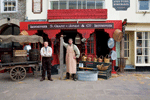
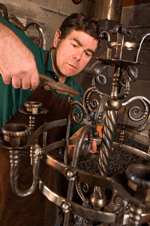
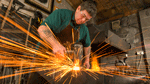
Submitted Photos: Simon1 - Simon on set and in costume for the BBC show. Simon 4 and 5 - Simon Grant-Jones at work in his forge in Sutton Poyntz.
For more information about the BBC series go to the website.
Based near Dorchester, Kingston Maurward College offers inspiring and challenging education and training opportunities to equip learners with the knowledge and skills to succeed in life and work. The college is set in a stunning 750 acre estate complete with a Georgian main building, commercial farm, laboratories, training areas, animal care unit and new £1m purpose built skills centre. Course areas include agriculture, horticulture, outdoor adventure and sports coaching, countryside management, foundation learning, animal care, equine studies, construction, army preparation, IT business and professional, and business administration and finance.
For more details: Visit www.kmc.ac.uk or call Jeannie Lunn, marketing and communications manager, on 01305 215035.
COMBINED SEMINARS FOR EQUINE PROFESSIONALS
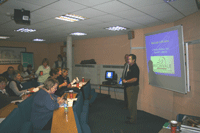
The 3rd Combined Seminar for Equine Professionals was held at Warwickshire College, Moreton Morrell on Saturday/Sunday 18th/19th September 2010, it was again attended by a good number of delegates who are working professionals from different fields of the equine industry.
The seminars are organised by Tony Nevin (Osteopath) and Martin Reed (Farrier), the main idea of the seminars is to establish not only a good working relationship with our fellow equine colleagues, no matter what they practise, but also be able to understand some of the basic fundamental workings of areas that each of us do not normally work in, and hopefully delegates will be able to combine these different professions for the horse’s benefit. The seminars can also be used as a source of different knowledgeable people who could help you with a problem or to offer an idea into the think tank and see what answers may be given.
Saturday started with some excellent lectures being given to our delegates. David Gill AFCL, a farrier from Nottingham, started the day by presenting his lecture “The Total Concept of the Whole Horse”. David has written a book on this subject and his lecture covered various aspects looking into the farriery trade, a horse’s stance and its overall conformation and locomotion. David gave our delegates some very interesting views on his approach to not only his way of working but also some of his own ideas about how to assess the horse prior to shoeing. One very interesting point that David came up with was the relationship between the different hoof shapes and sizes and comparing the length of the lower limb by using a T-square that he has invented for this purpose.
The next presentation was given by Dr Chris Colles, BVetMed PhD, HonFWCF, MRCVS, RVCS and a Specialist in Equine Surgery (Orthopaedics) from Avonvale Veterinary Practice. His presentation covered “Lower Limb Deformities in Youngstock”; Dr Colles has many years of experience in this field and gave a very interesting and practical view to the subject. Dr Colles covered various deformities from the knee down to the hoof capsule and explained how these problems can be corrected by stud management (environment/dietary care), farriery work (trimming/shoeing) and veterinary intervention (surgical). Dr Colles’s overall approach to this problem was to try to allow nature to do its best in the first two weeks, and then allow the farrier to correct it with foot trimming or maybe with the aid of some remedial work as well. If this approach does not succeed then surgical treatment may have to be carried out by a veterinarian. There are various methods of treatments which can be applied; these are stapling, periosteal strip, and/or physeal stimulation. Shockwave treatment can also be used, usually given by an equine therapist.
This was followed by Mr John Williams MA, VetMB, MRCVS, who is also from Avonvale Veterinary Practice; he gave a lecture on “Equine Dental Care”. Mr Williams is not only one of the working vets at the practice but is also a member of the Senior Veterinary Show Jumping team for Great Britain, which he has represented all over Europe. His riding experience helps him to assess a horse’s teeth and compare this with how the horse may be working/mouthing through feedback felt via the bit when the horse is worked. Mr Williams covered the various aspects of how the horse’s teeth are formed and grow, how they work together to allow the horse to eat and he also covered many of the problems associated with misaligned, damaged and infected teeth that may cause difficulties with a horse mouthing the bit correctly or cause an imbalance in its muscular structures. Mr William’s presentation was covered by written notes, some excellent x-rays and two horse’s skulls, one of which had a very rare problem with its teeth; this allowed the delegates to have a “hands-on” approach to something that they may not see during their normal working days.
After the lunch break, a visual assessment of a horse with lower limb deformities was given, prior to shoeing, by Mr Ron Ware FWCF. Mr Ware is a very well respected farrier whose career has spanned several decades in which he has worked on various types of horses. He has also worked for The Animal Health Trust in Newmarket, The Jockey Club in Hong Kong and Ron worked for Avonvale Veterinary Practice as their remedial farrier before he retired.
The horse was walked and trotted up in front of the delegates so that they could assess its conformation, limb movement, foot flight and placement. All of the different aspects of shoeing were discussed prior to the horse being shod. The horse was then taken into the forge so it could be shod, Mr Ware described and showed the delegates how he assess the lower limbs and foot balance before the shoeing process began. The practical work was carried out by Martin Reed, under the watchful eyes of Mr Ware. After the shoeing had been completed, the horse was walked and trotted up in front of the delegates again. It was agreed that the horse’s movement had improved.
On Sunday, Mr Russell Guire, Bsc Hons (Equine & Human Sports Science) from Centaur Biomechanics, opened the day with his presentation on “English Astride saddle v Side saddle” using an equine analysis programme. This proved to be a very interesting study, not yet completely solved due to more research required, but it instantly showed that there was a difference between the two different types of saddles, the horse’s movement and the rider’s position. The study was carried out by using two different dressage horses; one was a mature horse the other was a young horse learning its trade. These were then ridden by their owners using their own tack. A series of movements and dressage paces were then performed by the riders and their horses. Each horse and rider had a series of reference markers placed onto them so that the measurements could be analyzed correctly. One of the horses trailed showed that it had a varied range of measurements when ridden under the two different saddles, it was not proven that it was just the saddle that made the difference, it was asked by the delegates that further studies should be carried out. Not just to cover the different saddles but also the horse’s muscular/skeletal conformation, its movement, posture and the riders seat/style.
Dr Chris Colles followed afterwards with his second presentation of the weekend, “Differential Diagnosis of Back Problems in Horses”. Dr Colles explained about the differences in using Infra Red Thermal Images and what would class as acute and chronic back problems. The first part of his presentation covered some of the problems that are encountered prior to filming, some of these included weather conditions, the thickness/colour of the horses coat, room temperature, how well the horse travelled, rugged or not and last but not least the camera operator. Dr Colles then proceeded to explain about some of the cases that have been seen by him at the veterinary practice, some were minor problems and then some were severe cases. In some of the extreme cases, where horses have had a very serious fall, often race horses or show jumpers, Dr Colles said that it is good practice to x-ray certain areas of the spine before allowing anyone to carry out any type of manipulative treatment. This was proven with two cases where the horses had suffered fractures to the cervical vertebrae and a fractured pelvis. At the end of Dr Colles’s presentation, he covered a modern technique of dealing with “kissing spines”; this was found to be very interesting to the delegates.
After the dinner break, the delegates were then given a “Hands-on (visual) Assessment” by Mr Tony Nevin, BSc (Hons) Ost, D.O., of the same two horses and riders previously used in Mr Guire’s presentation using the equine analysis programme. The horses were led in hand, walked and trotted away from and back towards the delegates without any tack on, then with just the tack (which included using the different saddles) and afterwards they were then seen ridden completing the same exercises as on the previous occasion when they were filmed for the earlier presentation by Mr Guire. Mr Nevin explained how he assesses the horse’s movement, muscle tone, use of the head carriage and limb movement when being walked, trotted and turned in a tight circle. He then went into further detail when the horses were ridden, going through all of the original paces and movements that were completed earlier on in the study by Mr Guire.
Last but not least, Ms Liz Oakenfold, D.O., Osteopath, demonstrated an unsedated osteopathic treatment. The horse that was used in this demonstration had been previously scanned with a thermal image camera under strict control conditions; this will show up the areas that are compromised. Ms Oakenfold does not use this type of information regarding the horses that she normally treats. The horse was assessed by Ms Oakenfold by observing it walk and trot away and back towards her in a straight line; the horse was then turned in a tight circle in both directions and asked to walk backwards. When the horse is walked and trotted in a straight line it gives you a very good view of how it uses all of it’s body to move, it lets you see if the horse is moving freely or whether it is over-working one aspect more than the others. When being turned in a tight circle the horse should, hopefully, curve its neck gently into the turn, flex evenly through its front end and cross the hind legs over each other when turning. Ms Oakenfold started her treatment by feeling the tone of the muscles through the horses body, then she moved down to the bottom of the left front limb and felt the amount of movement and flexion within the joints of the lower limb, she did this on all the other limbs before moving up to the horses body. Ms Oakenfold uses her finger tips to feel for the difference in muscle tone, this enables her to work on any areas that have gone into spasm or are just tight and knotted from prolonged contracture. The way that Ms Oakenfold treated the horse, looked like the same sort of osteopathic treatment that a human may be given, it was quiet, methodical with only the minimal amount of pressure being used. The horse’s neck is usually the last area that Ms Oakenfold treats, but in this case due to the horse’s assessment prior to treatment, she started treating the neck before the body as it needed to be freed early on in the treatment. Once the horse had been treated it was walked and trotted for the delegates to assess how much better the horse moved afterwards.
At the end of each day a question and answer session was given, questions could cover any of the presentations or ideas that may require a varied amount of solutions from all of the equine professionals who attended. The delegates were also asked by the co-ordinators for their feedback about the seminar and any items that they wished to see on future agendas. This has given the co-ordinators a large range of presentations/demonstrations that the delegates would be interested in seeing at the next seminar, which will be taking place at Warwickshire College, Moreton Morrell on Saturday/Sunday 17th/18th September 2011.
Tony and Martin would like to take this opportunity to thank all of the guests, Mr David Gill, Dr Chris Colles, Mr John Williams and the staff at Avonvale Veterinary Practice, Mr Ron Ware, Mr Russell Guire, Ms Liz Oakenfold and to Mrs Liz Rogers, Mrs Clarissa Dawson and their horses for being part of the practical demonstration. We would also like to thank all of the Equine and Farriery Departments at Warwickshire College for the use of their facilities, horses and all the hard work that was done by the members of staff.
Hope to see you all next year,
Tony and Martin.
UPDATE FOR COLLEGES AND COURSES
Forge Magazine, Unit 19, The Derwent Business Centre, Clarke Street, Derby DE1 2BU.
If any of the courses above have been ommitted or changed please send us an Email Forge or call us on 01332 331159..
ADVERTISEMENTS
















Forthcoming events
The most prestigious events in the calender are listed here ...
BFBA 2014
National Farriery Championships
Date: 23-24 July 2014
Where: The Royal Welsh Show
BFBA European Farriery Championships and Convention
Date: 25-27 July 2014
Where: Myerscough College, Preston, Lancashire
35th International Team Horseshoeing Competition
Date: 26-28 September 2014
Where: BFBA HQ, The Forge, Stoneleigh, Warwickshire